
Dangerous War Reporting
by John Fenn

John Fenn is a freelance open source intelligence analyst focused primarily on jihadist and designated terrorist output on social media (especially Telegram). In this essay, he critiques Al Jazeera Arabic for its reporting on X, noting how the war with Iran and Gaza has taken precedence over every other crisis in the world.
The 21st anniversary of the assassination of Samir Kassir in a car bomb attack on the streets of Beirut passed on 2 June. Kassir, a prominent Lebanese author and columnist of Palestinian heritage, was highly critical of the former Syrian regime of Bashar al-Assad and supported the Cedar Revolution in 2005. Nobody has been convicted of his death to this day and the likely masterminds of the attack, members of the Assad regime, are either dead themselves, in hiding, or living in exile.
The milestone 20th anniversary of his murder, by remote-controlled explosives attached to his Alfa-Romeo, was marked by friends, colleagues and independent media in Lebanon last year but went mostly unnoticed elsewhere in the region, or by foreign correspondents, and on UK shores. Perhaps we should not be surprised by this, as media attention pivots from one crisis to another in a bid for television views and clicks on social media.
Samir Kassir’s last book, Being Arab, available first in French in 2004, with an English translation published posthumously by Verso in 2006, left a lasting impression on me. I often return to my copy to remind myself of his insights on what he called the Arab malaise after the 9/11 attack on the United States, penned during the US-led so-called ‘war on terror’ in Iraq and Afghanistan.
Kassir wrote about the culture of death in the Middle East in the final chapter, the seemingly endless self-perpetuating logic of blood for blood. His explanation of the evolution of martyrdom-seeking resonated, especially the turbocharging in the modern era of the religious concept and battlefield tactic by Shia forces after the Iranian revolution in 1979. The success of Hezbollah suicide bombers in Lebanon, and by the Tehran regime during the Iran-Iraq war in the early 1980s, inspired many copycat attacks by Sunni designated terrorist groups (DTGs) like so-called Islamic State, Hamas and the Taliban[1].
Crucially, Kassir took aim at some of his fellow journalists for perpetuating this culture of death. Being Arab was published before the advent of social media, so his ire was directed mostly at Arabic broadcast media, notably Doha-based and Qatari state-run Al-Jazeera TV,[2] which at the time was sticking two fingers up to the West by airing the latest video statements by the masterminds of 9/11, Al-Qaeda leader Osama bin Laden and deputy leader Ayman al-Zawahiri, from the mountains and ravines of Afghanistan. Al-Jazeera also gave the Arab street a front row seat during the second intifada [uprising] against Israel, which witnessed many suicide bombings targeting civilians in cafes, nightclubs, and on public transport.
In a telling passage toward the end of the book, Kassir wrote:
The proliferation of the culture of death and the evening-out of differences between Shias and Sunnis cannot be explained solely by the Islamization of the fight against Israel. Over and above actual events, the media, especially Al-Jazeera, has played a key role in this process, peddling a lowest-common-denominator mix of Arab nationalism and Islamic nationalism. It was doing this before September 11 [2001], defending means, justifying ends, claiming Arab victimhood. The Arab public has been systematically primed to accept the thesis of a ‘clash of civilizations.[3]
Fast forward over twenty years, has much changed in terms of the media’s fixation on the culture of death and clash of civilizations? The situation is arguably much worse given the proliferation of social media and smartphones. Influencing public opinion has largely moved away from the smoke-filled cafes of the Arab world and is now online, with a plethora of platforms to obtain news on the latest world crisis.
Disinformation, hostile foreign-state information manipulation and interference, and AI-enabled deepfakes are now a real threat to information integrity and trust in media, but I would posit that narrative setting poses a similar risk to community cohesion and regional stability. What factors dictate conflict reporting in the media: is it the death toll, civilian and combatant alike, or the onset of starvation and disease because of complete civil society breakdown due to war?
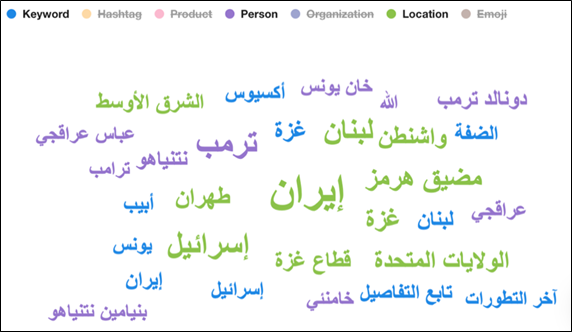
Judging by output from Al-Jazeera Arabic on X (formerly Twitter), the war with Iran and Gaza has taken precedence over every other crisis in the world. Analysis of the channel’s two most followed accounts (@AJArabic and @ajmubasher) shows that nearly every other post this year, up to 5 June, has been focused on the clash of civilisation agenda. A word cloud for Al-Jazeera output (a visual representation of most frequently mentioned words or short phrases) places Iran, Israel, Lebanon, Gaza and US President Donald Trump front and centre[4].
[The author welcomes external rebuttal or confirmation of this data analysis].
Other regional conflicts receive much less attention. For instance, the latest death toll from the tragedy that is the Sudan civil war is 150,000 and, by UN and aid agency estimates, over 14 million Sudanese are displaced and over 30 million continue to face malnutrition and require humanitarian aid. Yet this conflict mustered only 1.5% of posts on these two Al-Jazeera accounts on X during the same timeframe this year. Is that because two Sudanese military leaders battling for supremacy does not represent a clash of civilisations? That this is just a war between two rival Muslim generals and so does not warrant much mention. Or is that no Jews are involved?[5]
I would not mind if it was just reasoned analysis, because to give credit where credit is due Al-Jazeera does proffer Israeli perspectives as well, but I have routinely seen the latest Hamas, Palestinian Islamic Jihad, or Hezbollah logoed propaganda videos being posted unabridged on these two accounts. Over the last few years, it has been videos using the customary red-triangle and showing Israeli military hardware being blown up or soft-bodied soldiers, often part-time reservists, being killed. Or fighters installing makeshift mortar launchers, which you can clearly see alter elevation and azimuth on first firing, with zero verification on whether the explosive shells hit Israelis or Gazans. And not just viewing on my smartphone but also beamed straight into the comfort of my own living room in the UK on Freeview Channel 252. The same red triangles that are being brandished on the streets of cities and towns across most capitals as a symbol of resistance, but which really embody the desire to destroy the state of Israel.
I understand that news organisations have some leeway when reporting on conflicts and have exemptions from online safety laws but posting and airing full unredacted versions of UK-EU-US-proscribed and designated terrorist group (DTG) logoed propaganda videos must cross a red line. Especially the Israeli hostage videos in Gaza that were made under duress and breached all UN conventions and platform community standards. Media regulators like Ofcom need to pay attention and may be surprised to know that Al-Jazeera broadcasts have been banned, permanently or periodically, by Saudi Arabia, the UAE, Bahrain, Jordan, Egypt and the Palestinian Authority in recent years. Even the latest Middle East peace interlocutor, Pakistan, has acted against the channel. So, Israel is in good company when it comes to trying to ensure balanced news coverage.
To be fair to Al-Jazeera, there are more hardline channels out there. Most DTGs in the region have their own broadcast media, the common denominator being alignment with the Iranian regime and Tehran-based Islamic Radio and Television Union. Hezbollah have Al-Manar TV, the Houthis (Ansar Allah) in Yemen have also Beirut-based Al-Masirah TV, and the various Iraq-based DTGs have Al-Nujaba TV, Al-Etejah TV and Al-Ahad TV, among others.
And at least Al-Jazeera uses the word ‘Israel’ in their reporting; the hardline channels that follow the Iranian regime’s lead, espouse Shia martyrdom narratives, mostly use ‘Entity’ or ‘Zionist Entity’ instead. Their social media posts may occasionally add Israel in the text, if the report is sourced to Western media or an international body, but it will be in quotation marks to show contempt. Popular supporter accounts cross out the word Israel in a sign of defiance. A linguistic form of resistance if you like. They do not believe the state of Israel should exist, so why should the word survive online. The same applies with maps in studio discussions and newscasts; the state of Israel are often omitted and show a Palestine from the ‘river to the sea’, which is a blatant call for genocide. Or cities like Haifa are captioned as ‘Occupied Palestine’ despite being inside the 1948 UN-recognised border of Israel.
I often wonder what Samir Kassir[6] would make of conflict reporting if he were alive today. I suspect he would be hugely pleased to see the demise of the Assad regime and may have quietly praised the emasculation of Hezbollah in Lebanon but would feel to the very core the loss of innocent lives in Gaza and Lebanon. He would have been closely observing the continued Al-Jazeera and Qatari influence in the region and warning of the dangers of priming the Arab street for a clash of civilizations.
Media narrative setting distorts the true conflict picture and has consequences.
[1] The reporting of DTGs in the media is always a bone of contention. We got used to newsreaders describing the latest bloody actions of ‘so-called Islamic State’, the prefix used because not all Muslims endorse the group’s state-building agenda and religious authority. Why shouldn’t the same apply for the Islamic Resistance Movement [Harakat al-Muqawamah al-Islamiyyah in Arabic], instead of the blunted abbreviation Hamas? After all, not every Muslim is moved by the group’s resistance agenda against Israel in the name of Islam. When I was studying at an Islamic college, me and some other foreign students used to joke that the Taliban in Afghanistan were giving us a bad name [the name derives from the Arabic root verb to search for something, or study, and can be associated with religious students]. Liberals and socialists may think twice about chanting for the ‘Islamic Resistance Movement’ or the ‘Party of God’ when showcasing their pro-Palestine credentials.
[2] According to BBC Monitoring, Al-Jazeera is a ‘24-hour Arabic rolling news satellite TV network based in Doha and funded by Qatar’ which ‘avoids news or comment critical of Qatar’s rulers’. This article is focussed exclusively on the Arabic service, not Al-Jazeera in English.
[3] Kassir, 2006, pp.84-85.
[4] In 2024, the top three Al-Jazeera posts on these two accounts, by engagement, all showed support for Hamas: the most engaged post noted a US actors praise for Yahya Sinwar after confirmation of the Hamas leader’s death in an armchair; the second most engaged post was an extract of Hamas spokesman Abu Obeida’s statement reminding Hajj pilgrims on their way to Mecca that the ultimate objective of the 7th October attack on Israel was to liberate the third holiest site in Islam (Al-Aqsa Mosque in Jerusalem); the third most engaged post also coincided with Sinwar’s death and was an orchestrated video montage of Gazans praising him for being a father and leader to them all.
[5] The data was collected using a popular commercial social media monitoring tool, using the following Boolean keywords (see separate document for screenshots), and while indicative is not an actual representation of broadcast coverage on Al-Jazeera Arabic television.
Sudan: 1271 mentions [(السودان OR الخرطوم OR كردفان OR دارفور OR الفاشر OR السوداني NOT العراق)] [1.5% of total posts]. There were nine posts mentioning Iraqi PM Al-Sudani, which were omitted from the total.
Gaza/Palestine: 6820 [(غزة OR حماس OR فلسطيني OR فلسطين OR الفلسطينيون)] [8%]
Iran: 17651 [(إيران OR إيراني OR طهران OR “الحرس الثوري”)] [21%]
Israel: 9500 [(إسرائيل OR إسرائيلي OR “تل أبيب” OR نتنياهو)] [11%]
US: 8472 [(أمريكا OR أمريكي OR “الولايات المتحدة” OR واشنطن OR ترامب)] [10%]
Lebanon: 9229 [(لبنان OR لبناني OR بيروت OR “حزب الله”)] [11%]
[6] A foundation and centre set up in his name campaigns for media freedom and the protection of journalists. Monthly products highlight the number of journalists reportedly killed, injured or imprisoned, mostly in conflict zones involving Israel and DTGs but also in other states worldwide.
Excellent article, some important notes on how anti-extremist Arab journalism is so difficult and dangerous. As well, solid indications of the existence of Islamist DTG messaging and, imo, indoctrination that subverts and redirects truth. Very good starting point for further research. Thanks! Restacked and shared on FB.